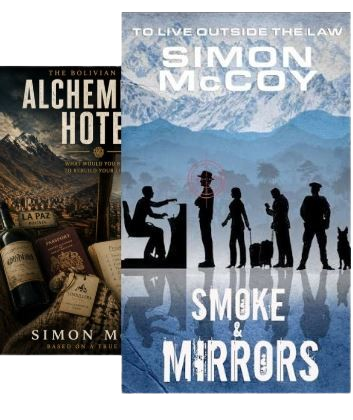
Book 2
Smoke& Mirrors
Smoke & Mirrors
Simon is no longer alone.
Joined by Steve, whose appetite for risk matches his own, what began as survival starts to scale. A legitimate business grows alongside something far less stable, blurring the line between reality and illusion.As the operation expands across continents, so do the pressures, personal, moral, and financial.With his life divided and his conscience under strain, Simon begins to realise that growth
comes with consequences no one can avoid.And not everything can be controlled.
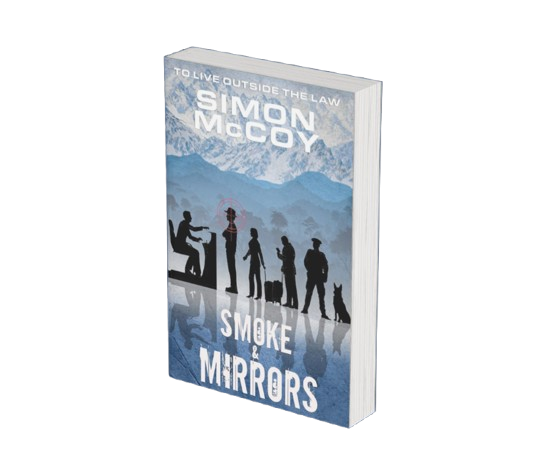
Book 2
Smoke& Mirrors
Chap 1
Attitude at Altitude
As the plane descended through the clouds towards El Alto, at 4,016 metres, the world’s highest airport, Los Andes lay out its immaculate white-crystalline welcome mat below. Like the conquistadors before me, I had come to Bolivia to get rich, though in my case, by putting my business into other people’s noses. I wasn’t arriving on horseback, but aboard a half-empty Aero Lloyd Boliviano 727.
The flight to La Paz had been a nervy four-hour haul from Rio. Ahead lay the first hurdle in this steeplechase: getting into the country unnoticed. But I was getting ahead of myself. First, I had to get in alive. I’d chosen my seat in Rio only after thoroughly inspecting the rear toilet facilities. Aero Lloyd’s safety record had recently hit a deadly speed bump. The month before, one of their 727s flying from La Paz to Santa Cruz had been blown apart by narco-terrorists who planted dynamite in the rear toilet.
A one-off, or the start of something? Perhaps I was about to find out. As the ground rushed up to meet us, my heart raced. The pilot wrestled with turbulence, which put the wind up me properly. I wasn’t just being paranoid. Alongside last month’s bombing in Santa Cruz, an Eastern Airlines flight had hit Mount Illimani the year before, killing twenty-nine passengers. Maybe those killers on horseback had known something I didn’t about safe travel. I slid across to the window seat to take in the view, crossing the fingers of my sweaty hands and hoping another crash wouldn’t turn me into part of the scenery. To steady my racing thoughts, I indulged in a little people-watching, reminding myself that I was hidden in plain sight.
Many of my fellow passengers were indigenous Bolivians in traditional outfits made from natural fibres, their colours owing nothing to modern chemistry. I could easily distinguish the three major groups and found myself trying to work out what separated them. Height was one clue. The Aymara tended towards the shorter side, softer-featured than their angular Quechua cousins, who were often mistaken for Incas with their Roman noses.
The third and more numerous group were the Mestizos, a melting pot of indigenous Bolivians and Spaniards dressed in western clothes, unlike their compatriots. In the years to come, I would learn some of their history and be privileged to call many of them friends — people from a distant land so different from my native Essex.
But right then, I was simply grateful for the distraction. The few Caucasian faces on the flight belonged mainly to backpacker kids in Levi’s and cagoules, hauling sprawling green and brown rucksacks, their long hair spilling over Sony Walk mans. I stuck out like a sore thumb. It was hard to believe I’d left La Paz only two months earlier. In those hectic weeks, I’d shifted more than a hundred grand’s worth of Bolivia’s finest marching powder across Europe, partied in Rotterdam with my Dutch buddies.
I converted the profits into stacks of hundred-dollar bills with Steve, my new partner, and the small crew we’d formed. I was the man with the plan and a job to do. The next mission had my complete focus. The plane hit the runway hard, and so did reality. A lot was riding on this trip. The next hour mattered more than the previous three years combined. After a long, stubborn learning curve, I finally had my ducks in a row. Eighty grand sat in my luggage alongside equipment that would take some explaining if anyone decided to look too closely. In a few days, Steve would fly out. The three keys of powder I’d moved in December —concealed cleanly, invisibly — had proved I could run this operation alone.
Now I was back, putting together nine more keys and repeating the trick, only this time everything was dialled in: new clients, guaranteed sales, an extraction method smooth as silk. If the maths held, we’d be back in Holland within weeks carrying a quarter of a million dollars’ worth of illicit plant extract. Or maybe I’d just been lucky. Steve and I both knew the odds: six years in a South American prison, or an unmarked hole in the ground if we mis-stepped. The airport was the first hurdle in the winner-takes-all steeplechase. Joining the throng of eager travellers, we pushed our way along the aluminium tube that had carried us from the bustling modern sprawl of Rio de Janeiro to La Paz, a South American backwater by comparison, barely a twentieth of Rio’s size.
An older woman struggled to reach her bags in the overhead locker while passengers jostled pasther. Dressed in full Aymara attire, with a crinoline skirt layered over a dozen petticoats, she reminded me of Queen Victoria, like so many Aymara matrons. Her brown bowler hat perched precariously above long jet-black plaits, constantly at risk of being knocked flying by the lockerdoor.I blocked the aisle and reached over her hat to rescue two recycled rice sacks stamped with USAID logos, placing them gently on the seat beside her. In return, she gave my hand a soft squeeze and flashed a shy ivory-and-gold smile. I took it as a good omen for the coming fray. Being six foot plus had its uses.
As I clambered down the plane’s stairs onto the concourse, the heady mix of dry earth, hot exhaust fumes and aviation fuel hit me hard. My skin felt clammy, my throat dry from the air-conditioning. I felt as grubby as the air I was breathing. There was no way of knowing how this adventure would unfold.‘ Hope for the best, plan for the worst, and you’ll be fine, love.’ That had been Gail’s sage advice after I’d admitted, in a weak moment, to feeling uneasy about the trip — and about leaving the luxury of her arms behind. I hadn’t asked my wife, Helen, for advice at all. As I approached the airport doors, my mind drifted towards what the worst-case scenario might actually look like.
Two delightful black-and-white Cavalier King Charles Spaniels appeared in my imagination, tails wagging, mouths open in canine laughter. One suddenly stopped beside my bag, snuffled around it, then sat looking hopefully up at its handler.‘ Excuse me, sir, is this your bag?’ I shoved the image from my mind before it could take hold. Immigration is the hurdle that begins and ends every international journey. I ducked and weaved along the stark corridor towards passport control. Despite sitting at the back of the plane, my stride easily outpaced most of the passengers ahead of me. Then, with the prize in sight, a bearded Mennonite in his forties blocked my progress.
He wore black trousers held up by red braces over a white cotton shirt and kept urging his exhausted-looking wife to ‘watch little Isiah’. She drifted along in a pale blue pinafore dress and white bonnet, struggling to man oeuvre a pushchair carrying a screaming baby while Isaiah pinched sweets from its fists. Two younger boys staggered ahead beneath black canvas bags almost as large as themselves. The father hauled a colossal rucksack on his back while wrestling a reluctant toddler under on ear, the child yelling and kicking in protest. A lucky kick from the wild toddler sent the man’s straw boater frisbeeing off to the right.
He lurched after it, and my heart went out to him even as my feet skated neatly left around the entire family. From there, it was plain sailing. I strode past the stream of passengers dragging wheelie bags and other unconventional hand luggage, streaking in from behind to reach the front of the immigration queue without breaking a sweat. Only the business-class passengers stood ahead of me. At three times the price of my bucket-shop ticket, it was a luxury I couldn’t afford yet. The next hour was crucial. My nerves were jangling. I needed to clear this obstacle course without being noticed.
Then a diminutive cholita nudged me aside, knocking the strap of my rucksack from my shoulder as she slipped into my place in the line. She stood knee-high to a Bolivian grasshopper, all muscle and petticoats.I didn’t argue. At the kiosk ahead, a woman in an olive military uniform scrutinised the documents of a suited-and-booted Mestizo. Sweat dripped from his forehead into his open briefcase. The temperature was barely fifteen degrees, but he was getting the third degree. Better him than me. Immigration should be easy, I reminded myself. Customs was where everything could still turn to shit. I hadn’t flown into La Paz before. Leaving the city had been serious enough, but I’d had coke in my bags then. Coming back, I’d convinced myself, would be straight forward. At that moment, though, I wasn’t feeling so confident.
My hands were clammy and my bowels churned; worse still, my mouth had gone dry, and I needed to deal with that fast. I always carried something to suck on to avoid the problem — a dry mouth was a huge giveaway, not to mention bloody uncomfortable. With growing urgency, I rifled through my pockets, then dived into my backpack. Fuck. I must have left the sherbet lemons on the plane. A careless mistake. I’d changed seats to watch the landing and probably abandoned the packet in one of the seat pockets across the row. My mind immediately told me what I didn’t want to hear: everything could still go wrong, right there and then.
I tortured myself with the thought that I should have done a dry run first. Had I been careless? Had I walked mindlessly into this? Fear lived in the unknown, alongside its faithful companion, foolish mistakes. I reminded myself I had no choice. We owed money to Helen’s mum, and I’d never be free until the debt was paid. But the truth was, I wasn’t even sure I wanted to be free. Not from Helen, of course. I’d loved my wife for half my life. The debt had become a convenient trap of my own making, something to push me forward, to keep me moving down this dangerous road while pretending it was bravery instead of cowardice. The truth was that I could have paid Helen’s mum back instead of being here. Instead, I was moving coke and conveniently avoiding deciding which woman I loved most. I slipped my hand into my inside jacket pocket and felt the reassuring brick of cash — a wad of hundreds reserved for eventualities. Then my mind caught up with itself. What idiot would accept a five-thousand-dollar bribe to overlook eighty grand? The stack of money suddenly lost its magic. Two white GI Joe types materialized off to one side. Their crew cuts and aviator shades screamed DEA. A dribble of paranoid saliva slid down my throat and turned my stomach.
Had I raised red flags somewhere along the line? If I had, these were exactly the sort of blokes who’d be waiting for me. Rudi, my local connection, hadn’t replied in days, had something happened to him?Paranoia came with the territory.
I told myself to stop imagining things. Not for the first time, I wondered whether this was really the job for me. Determined not to make eye contact with the GI Joes, a tactic equally useful with plod and rottweilers, I dropped my rucksack to the floor.
Then another uniform waddled into an adjoining booth and opened up shop. Passengers surged towards the new ‘checkout’ like shoppers chasing a fresh till at the supermarket.
My Queen-Victoria-in-the-bowler-hat cholita lunged across the aisle, grabbed me by the arm and dragged me with her towards the forming queue. With so many women dressed alike in Aymara skirts and bowler hats, I hadn’t realised it was my locker buddy.
I grabbed one of her rice sacks as we crossed the aisle. Five people had already beaten us to the new line, not one of them a gringo. Glancing back, I was pleased to see the Mennonite family still stranded well behind us, the men from Mennon safely distant from the man chasing Mammon. In exorably, the queue shuffled forward. I dried my damp hands against the lining of my pockets.
My bowler-hatted companion passed through immigration wordlessly in a trice. Then it was my turn. As I handed over my passport, sweaty fingerprints clung stubbornly to the cover. I bit the inside of my mouth, coaxing enough saliva to free my tongue from the roof of my mouth. A sour smell hung in the air. T
he passport officer looked the part. Thickset from a sedentary life, he’d clearly just finished lunch; scraps that had missed his moustached mouth decorated his grubby shirt and half-buttoned military jacket.
He opened my blue passport, and suddenly the cacophony of the immigration hall melted away. The crowd disappeared. It was just the two of us.
‘De dónde vienes?’ came his falsetto voice.
I took half a step back. I’d expected a baritone.
Thrown slightly off balance, I replied hesitantly. ‘I’m sorry. No habla español.
’‘Okay, okay. Where are you from? ’
‘Rio de Janeiro.
’‘No. Where from?’‘
Oh, England. I’m English.’
He turned the sticky British passport over in his hands as though it were the first one he’d ever seen.
A young woman in olive green appeared beside the booth carrying a rifle almost as large as shew as.
She edged closer and listened intently. The noise of the hall crashed back over me like a wave as my awareness returned.
The stocky immigration officer continued his Mickey Mouse interrogation.
‘Why are you here?’‘
Tourism,’ I answered, then added weakly, ‘and to meet a friend to visit Lake Titicaca.’‘
Where do you stay?’‘
Hotel Sheraton.
’‘How long?’‘
One month.’
I was having difficulty with that voice. A nervous laugh is the classic tic of a guilty man, not a good look, and dangerously easy to fall into. His squeak was testing my discipline; every time he spoke, I had to stifle a grin.
The girl with the gun leaned into the booth, studied the computer screen, scribbled something on his pad, then slipped the note into her pocket before whispering in the official’s ear.
Had she just told Mickey Mouse to get a move on, or was it something more sinister?
I shivered. The hall was cold, but I was colder.
My falsetto friend grudgingly selected a clean page and stamped it with a resounding thud. Slamming the passport shut, he shoved it back at me like a parking ticket. I didn’t dare thank him for fear he’d reply. One more exchange and I knew I’d collapse into giggles.
With my passport finally back in my hand, I dropped onto one knee to hide the wobble in my legs, twisting to retrieve my rucksack while scanning for the missing Yankee DEA goons. The girl with the gun had vanished, too.
Sweat trickled down my back. I resisted the urge to scratch. Slowly, warmth returned to my muscles.
This was going well.
I swung the rucksack onto my shoulder, my mouth no longer Sahara-dry, and headed towards the baggage hall with what I hoped was a nonchalant gait.
Coast to coast and into Key Largo, western style.
The cavernous corrugated-iron baggage shed was chaos. Porters clambered over a mountain of luggage. There was no conveyor belt, just an eclectic heap of belongings strewn across the airport floor.
People shouted and gesticulated, scrambling over their own bags and everyone else’s, a Hogarthian vision of disorder. Suitcases, sacks and hold alls were launched from a small pick up truck by two sturdy baggage handlers. Some burst open on impact, bleeding underwear, blouses and shoes across the concrete floor.
A bewildering sight.
I knew my cases were overstuffed. If one split open, there’d be a lot of explaining to do. I scanned the luggage pile anxiously for my Globe-Trotter bags and beamed when I spotted them: bright blue, straight out of the Raj, and standing to attention unscathed, tough as a sergeant major’s hide.
‘Your baggage, Mister?’
The scrawny older man seemed held together by battered blue overalls and ancient scuffed boots. Copper-skinned and wiry, he stared up at me with a huge smile. I clutched at his friendliness immediately. My mood lifted; suddenly, I was no longer alone. I had my Passepartout. Since Helen had left me at the airport that morning, I’d felt exposed.
I pointed towards my two identical cases. The porter waded into the melee and launched bothtowards me in quick succession. A trolley materialised from nowhere, and I nodded at it.‘
How much?’
He shrugged. ‘Good price.’
This wasn’t the moment to haggle. He felt like a get-out-of-jail-free card. His quiet confidence— the confidence of a man on home ground was infectious, wrapping itself around my nerves.
‘What’s your name?’
‘Jorge.’‘
Okay, okay, let’s go, Jorge.’
Masterfully, he stripped the rucksack from my shoulder and stacked the cases onto the trolley. Ahead of us loomed customs: the final hurdle in the formalities steeplechase.
Locals probably smuggled more things into the country than gringos smuggled out. I reckoned that gave me an edge.
I was an exception to the no-smuggling rule. Packed neatly into my two cases were sixteen tiles of $100 bills, a Buchner filter, a hotbox for testing cocaine purity, heat-shrink bottle caps, rolls of plumber’s tape, a butler’s corkscrew, a heat gun, and assorted tubes and rubber bungs. I’d even slipped in a disguised copy of the Cocaine User’s Handbook and now had to get it all through customs without anybody asking why.
An army of customs agents waded through the baggage.
Jorge plucked my customs declaration from my hand and headed for the inspection bench. One officer waved away his latest victim, and suddenly we were standing before him.
Short and stocky, with unshaven jowls, he looked like a pug in uniform. With encouraging disinterest, he pointed at my rucksack. Jorge placed it on the bench, and the official began rifling through it.
Then the customs guy froze mid-search and gestured for me to step aside.
‘You have whisky?’ he whispered.
I shook my head.
‘Wait, please.’
Oh, thank God he’s a baritone, was my first thought.
Concern came second. Waiting for what? Or for whom?
My customs man stalked off behind the line of rummagers to confer with the boss. You could tell he was the boss; he had the X-ray machine and a comfortable chair. The two men talked conspiratorially for what felt far too long, never once glancing in my direction while I fought to look unconcerned.
A nonchalant scan of the hall confirmed there was still no sign of the crop-haired GI Joes. The girl with the big gun had vanished, too. That was a plus.
I slipped a hand inside my jacket pocket. The half-brick of hundreds was still there.
I shot Jorge a querulous glance, and he grinned back. Illogically, it helped.
To my left, my cholita was getting the once-over, her bags spread across the bench while two olive-drab women tore through them.
I pictured how all the kits in my cases might look under an X-ray machine and began rehearsing excuses. Trying my best to appear bored, I yawned, unaware at the time that it was a tell. Luckily, nobody seemed to notice.
After an eternal five minutes, the uniformed pug returned.
‘Where from?’
‘Rio.’
‘How much money do you bring?’
‘Five thousand.’
‘Nothing to declare? Electricals? Whisky?’
‘No.
’The official grunted.
‘Next time you bring whisky, it’s quicker.’
He tossed my customs form onto the pile behind him, pointed towards the exit without looking at me, and moved on. The bastard had been taking the piss all along.
I buried the grin rising inside me. Jorge was already through the doors by the time I gathered up my rucksack.
Glancing back at my cholita, our eyes met briefly, and I gave her a conspiratorial shrug. She’d been my companion through the whole obstacle race. My good-luck charm. It would have been nice to think I’d been hers.
But formalities are a sprint, not a relay. I couldn’t take her baton and run with it, even if I’d wanted to. I wasn’t safely over the finish line myself yet.
The electric doors swished open as Jorge hit them with the trolley.
We were out.
Break Point
My customs man stalked off behind the line of rummagers to confer with the boss. You could tell he was the boss; he had the X-ray machine and a comfortable chair. The two men talked conspiratorially for what felt far too long, never once glancing in my direction while I fought to look unconcerned.
A nonchalant scan of the hall confirmed there was still no sign of the crop-haired GI Joes. The girl with the big gun had vanished, too. That was a plus.
I slipped a hand inside my jacket pocket. The half-brick of hundreds was still there.
I shot Jorge a querulous glance, and he grinned back. Illogically, it helped.